Connect this guide with the rest of your visit in the Makkah trip planner. Read how the research is made and what its sources establish.
At a glance
Start here
- Treat the exhibition as an archive made of objects, images, documents and models.
- Use labels to separate original fabric, later intervention, model reconstruction and service equipment.
- Compare object scale with building scale rather than rushing through isolated highlights.
- Verify current admission arrangements directly because descriptive official pages do not guarantee access.
01
An archive distributed across seven halls
Discover Makkah describes an exhibition of seven halls devoted to aspects of the Two Holy Mosques' architecture and history. The hall structure matters because no single artifact can carry the whole story. A model can explain mass and circulation; a fragment can reveal material and workmanship; a photograph can preserve a lost arrangement; a document can date or authorize a change; a service object can show how the building was used and managed.
Approach the visit by evidence type rather than by a race to the most famous object. In each hall, ask what kind of record is present and what question it can answer. This avoids treating a model as an original, or a later service object as evidence for an earlier construction phase. The exhibition becomes clearer when every item is allowed to speak within its own limits.
- Models explain relationships and scale.
- Fragments preserve material evidence.
- Images record previous states.
- Documents anchor decisions and dates.
- Service objects reveal operation and stewardship.
02
Models are arguments about relationships
Architectural models compress a complex place into a view that no visitor can obtain at full scale. They can clarify the position of courtyards, entrances, vertical elements and successive built zones. That clarity is selective: a model has a date, scale and interpretive purpose. It should not be assumed to represent every historical period at once or every current operational detail.
Read the label before photographing the model. Note the represented period and whether the piece reconstructs, documents or proposes a state. Then compare one relationship—such as the connection between an open space and surrounding structure—rather than trying to memorize the entire object. Official exhibition descriptions establish the presence of models, but the specific label must govern any claim about what an individual model depicts.
Sources: Discover Makkah, Royal Commission for Makkah City and Holy Sites; Saudi Press Agency03
Move from fragment to building
A detached architectural element can appear decorative until its original job is recovered. Material, tool marks, fixing points, inscription and weathering may indicate where it belonged and how it functioned. The official exhibition overview highlights architectural components alongside models and documentary material, allowing a visitor to move between close physical evidence and the larger building context.
Use a three-step note: identify the object's material and form, record the label's original location or function, and find the corresponding area in a model or photograph if the exhibition provides one. Do not fill a missing connection with guesswork. The value of a fragment is precisely that it is partial: it lets the surface, thickness and workmanship of architecture be examined at human scale while other records restore its setting.
- Describe the visible material.
- Record the labelled provenance.
- Reconnect it to a model, image or document only where evidence supports the link.
04
A gilded object preserves an architectural episode
Saudi Press Agency coverage identifies a gilded copper artifact associated with the Kaaba's Mizab among the exhibition's rare holdings. Read as architecture, it combines material, water-management function, ornament and a documented relationship to an exceptionally important structure. Its museum setting permits close attention that would be impossible at the scale and distance of the building itself.
The responsible method is to stay with the artifact's official label and current institutional account. Record its material, stated association and the period or intervention described there; avoid turning visual resemblance into a claim about date or original position. Pairing the object with a model or archival image can restore context, but the physical artifact remains a particular survivor, not a miniature substitute for the whole building.
Sources: Saudi Press Agency; Discover Makkah, Royal Commission for Makkah City and Holy Sites05
A barrier records the management of space
Another Saudi Press Agency report focuses on a rare early crowd-management artifact from the Grand Mosque. It broadens the idea of architectural history. Buildings are shaped not only by walls, columns and decorative programs, but also by the devices and procedures used to organize movement within them. A barrier can therefore document an operational response to density and circulation.
Compare this object with the exhibition's architectural models. The model presents spatial capacity and connection at building scale; the barrier shows an intervention at body scale. Together they reveal that the history of a major religious complex includes the ongoing management of people as well as construction. This is not evidence for current crowd-control practice, and visitors must follow present-day official directions rather than extrapolating from a museum object.
- Building scale shows spatial organization.
- Object scale shows a particular operational response.
- Current operations require current instructions.
06
Let photographs and documents control chronology
Historic photographs can show arrangements that no longer survive, while plans, records and inscriptions can connect change to a time or decision. The exhibition's official descriptions include photographic and documentary evidence alongside objects. That combination helps prevent a common museum error: assuming that everything displayed belonged to the same moment.
Choose one element and trace it across evidence types. A photograph may show it in place, a fragment may preserve its material, and a document may explain a later change. Write dates exactly as the labels give them and leave a gap where the sequence is not established. A careful chronology is more illuminating than a sweeping statement about continuous appearance, particularly in buildings that have undergone many phases of care and expansion.
Sources: Discover Makkah, Royal Commission for Makkah City and Holy Sites; Saudi Press Agency; Royal Commission for Makkah City and Holy Sites07
Visit with one question and a current check
A focused question makes seven halls manageable. Ask how a material changed, how a model represents an earlier state, or how service equipment shaped use. Select one object, one image and one model that help answer it. This small evidence set produces a coherent visit without forcing unrelated displays into a universal narrative or repeating label text without interpretation.
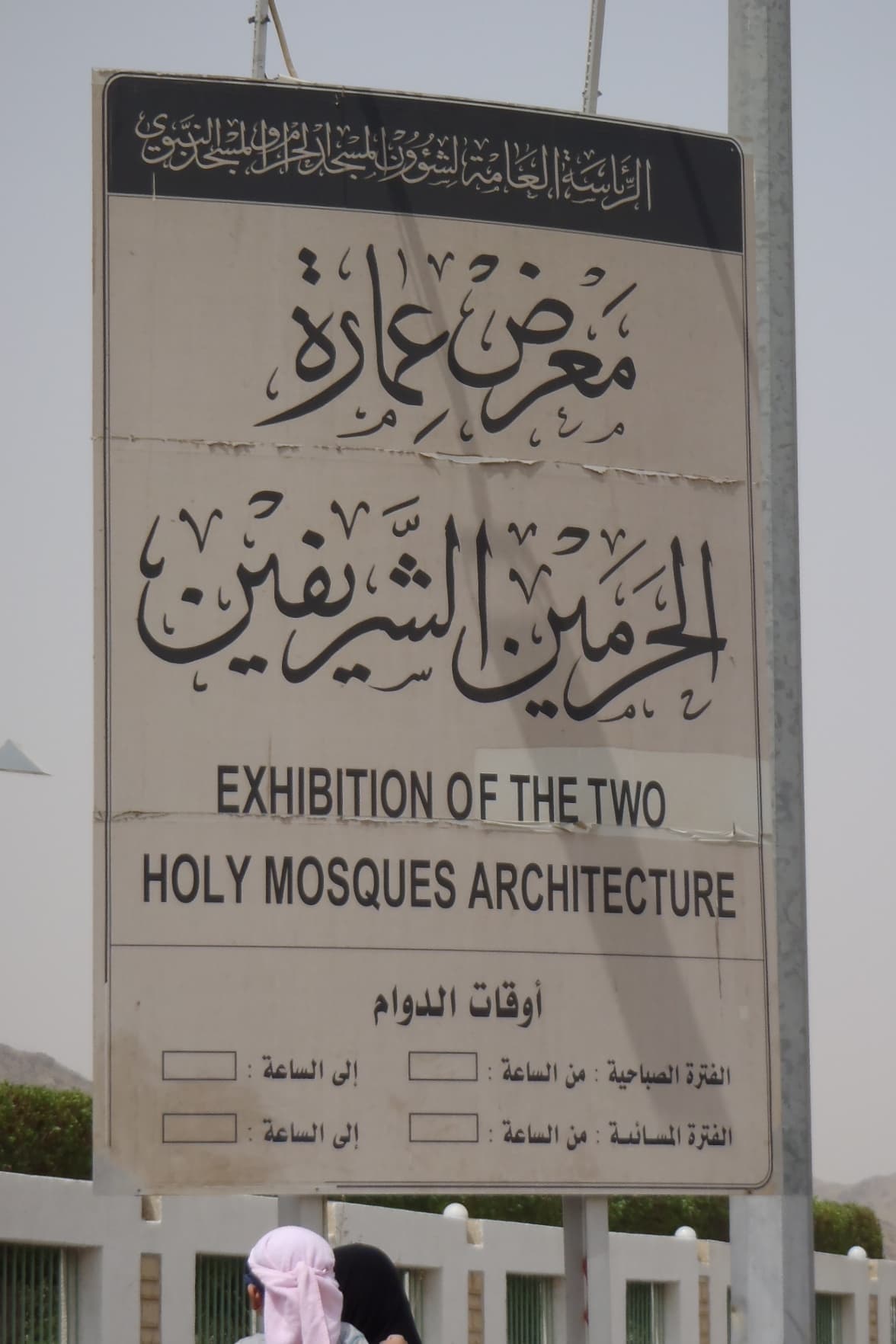
Before travelling, check the responsible official venue source for current admission, reservation and operating information. The reviewed descriptive pages and recent news reports confirm the collection's interpretive value, but they do not establish that the exhibition is open to every visitor at a particular time. The photograph assigned to this article shows the exhibition's signed exterior context, not live opening information; blank or old schedule panels must never be read as today's hours.
- Choose one architectural question.
- Connect three different evidence types.
- Photograph labels where permitted.
- Verify live venue access separately.
Useful answers
Reader questions
What kinds of evidence does the exhibition contain?
Official descriptions identify seven halls with models, architectural elements, inscriptions, photographs, documents and service-related objects concerning the Two Holy Mosques.
Sources: Discover Makkah, Royal Commission for Makkah City and Holy Sites; Saudi Press AgencyWhy is a crowd-management barrier part of architectural history?
It records how space and human movement were managed at body scale, complementing models and building fabric. It should not be used to infer current operating practice.
Sources: Saudi Press AgencyDoes this article confirm current exhibition hours or admission?
No. The official pages reviewed support the collection and individual artifacts, not a guaranteed visit time. Check the responsible venue's current notice or reservation channel.
Sources: Discover Makkah, Royal Commission for Makkah City and Holy Sites; Royal Commission for Makkah City and Holy SitesRead the evidence
Sources and further reading
These sources support the relevant sections above. Plans and comparisons are editorial suggestions. Check operators for current arrangements.
- Exhibition of the Architecture of the Two Holy Mosques ↗Discover Makkah, Royal Commission for Makkah City and Holy Sites · Research date 14 September 2026
The seven-hall structure and the exhibition's range of architectural, photographic and documentary material.
- Rare Gilded Copper Artifact Highlights Two Holy Mosques' Architectural Legacy ↗Saudi Press Agency · Research date 14 September 2026
The gilded copper artifact associated with the Kaaba's Mizab in the exhibition collection.
- Two Holy Mosques Exhibition Showcases Rare Artifact of Early Crowd Management at Grand Mosque ↗Saudi Press Agency · Research date 14 September 2026
The early crowd-management artifact and its connection to the Grand Mosque's operational history.
- Two Holy Mosques Architecture Exhibition: A Journey Through Time ↗Saudi Press Agency · Research date 14 September 2026
The exhibition's preservation of models, objects, photographs and records across architectural history.
- Historical Sites Guide ↗Royal Commission for Makkah City and Holy Sites · Research date 14 September 2026
Official placement of the architecture exhibition within Makkah's museum and heritage offer.