Connect this guide with the rest of your visit in the Makkah trip planner. Read how the research is made and what its sources establish.
At a glance
Start here
- The Kiswa is produced through linked stages rather than as one continuous craft act.
- Natural silk, machinery, skilled handwork and precious-metal embroidery all belong to the documented process.
- Design consistency depends on coordination between preparation, weaving, printing, embroidery, assembly and inspection.
- Current workshop access must be verified directly; this article makes no admission or booking guarantee.
01
One object, many coordinated workflows
Saudi official sources describe a complex rather than a single workshop bench. That distinction matters. A large textile covering with repeated inscriptions and precisely positioned ornamental areas requires material preparation, controlled weaving, design transfer, specialist stitching, joining and quality review. Each group works on part of the outcome, yet the viewer must perceive a coherent whole rather than a sequence of separate departments.
Think of the Kiswa as a system with dependencies. Weaving determines the textile ground available to later work. Printing or design transfer guides placement. Embroidery builds raised and metallic detail. Assembly aligns panels and components. Inspection checks whether the stages agree. The value of the official production story lies not only in extraordinary hand skill, but also in the planning that lets many hands and machines contribute to one exact object.
- Prepare the material.
- Create the textile ground.
- Transfer the planned design.
- Build embroidered elements.
- Join and inspect the finished components.
02
See silk as an engineered material
The Saudi Press Agency identifies natural silk as the foundation of the Kiswa and emphasizes the precision of its manufacture. Silk is not just a luxurious surface. It must become a stable, consistent textile capable of supporting woven pattern, applied design and dense embroidery across large components. Preparation decisions affect the appearance and behavior of everything that follows.
A finished photograph hides that material transformation because the eye jumps to calligraphy and contrast. To read the craft more carefully, begin with the field beneath the ornament: its regularity, depth and response to light. Then notice how heavier embroidered areas sit on that field. The relationship shows why raw material control and textile engineering are inseparable from the more visible artistry. Official sources support the material and process framework; they do not justify invented recipes or workshop parameters.
Sources: Saudi Press Agency; General Authority for the Care of the Affairs of the Grand Mosque and the Prophet's Mosque03
Modern machinery and hand skill share the work
The General Authority's Kiswa account refers to modern machinery, while official descriptions also foreground specialized manual embroidery. These are not competing stories. Machinery can establish consistency and handle particular textile operations; skilled makers can control raised lettering, metallic thread and complex detail where judgment and exact hand placement remain central. The production identity comes from the combination.
This mixed method is a useful correction to two easy assumptions: that heritage craft must exclude technology, or that machinery removes the maker. At the complex, the documented process preserves a highly specialized visual tradition through contemporary production capacity. When describing it, name the contribution rather than romanticizing it. Machines, prepared designs and manual work each solve different problems, and the authority's production system coordinates them toward the same standard.
- Mechanization supports repeatability.
- Specialist handwork builds detailed embroidered forms.
- Coordination keeps scale and placement consistent.
04
Design must move accurately between stages
The Discover Makkah complex page describes printing among the production departments. In this context, printing is best understood as part of transferring an approved design into a form that later specialists can execute, not as the final decorative surface. Letterforms, frames and repeated motifs need defined positions before embroidery can build volume and sheen over them.
That transfer creates a bridge between design and making. A tiny placement error can become more visible as materials accumulate, so the underlying organization matters even when it disappears beneath finished work. Visitors studying official images can compare repeated bands and framed elements to see the discipline of layout. They should avoid claiming a precise proprietary technique unless the authority explains it; the supported point is that planned design, printing and embroidery are connected departments in a controlled workflow.
Sources: Discover Makkah, Royal Commission for Makkah City and Holy Sites; Saudi Press Agency05
Embroidery turns line into relief
Official Saudi Press Agency reporting highlights embroidery using gold- and silver-plated threads. In the finished covering, these areas do more than add colour. They create relief, catch changing light and make calligraphic and ornamental zones legible against the silk field. The effect depends on controlled edges and consistent height across long and repeated compositions.
Look at close official imagery in layers: first the boundary of a letter or motif, then the raised body, then the way adjacent elements hold a shared baseline. This method reveals work that a distant photograph compresses into a gold band. It also keeps the interpretation material rather than devotional. The subject here is how textile, metallic thread, relief and alignment combine—facts supported by official production coverage—without claiming private knowledge of individual makers or undocumented stitch counts.
- Outline defines the form.
- Built volume creates relief.
- Metallic surfaces respond to light.
- Alignment makes separate elements read as one composition.
06
Assembly restores the whole object
Production necessarily divides a very large covering into workable elements, but assembly must remove the visual sense of division. The official complex account includes sewing and joining functions within the larger set of departments. Alignment is therefore both structural and graphic: textile edges have to meet while bands, frames and proportions continue across the finished composition.
This stage makes the earlier dependencies visible. Consistent woven ground supports a clean join; accurate design placement helps neighboring elements meet; controlled embroidery prevents distortion at an edge. Inspection then concerns relationships, not only isolated workmanship. A useful craft narrative follows that chain instead of presenting a single artisan as responsible for every operation. The Kiswa is an institutional achievement built from specialist contributions whose success appears as unity.
Sources: Discover Makkah, Royal Commission for Makkah City and Holy Sites; Saudi Press Agency07
Plan around evidence, not assumed access
Discover Makkah's page for the King Abdulaziz Complex describes prior coordination and a reservation route. Such arrangements are mutable: availability, eligible groups, timing and the responsible booking interface can change. The page establishes that visitor coordination has existed, but it is not a permanent promise that an individual can enter on a chosen date. Recheck the current official record and obtain explicit confirmation before building transport around it.
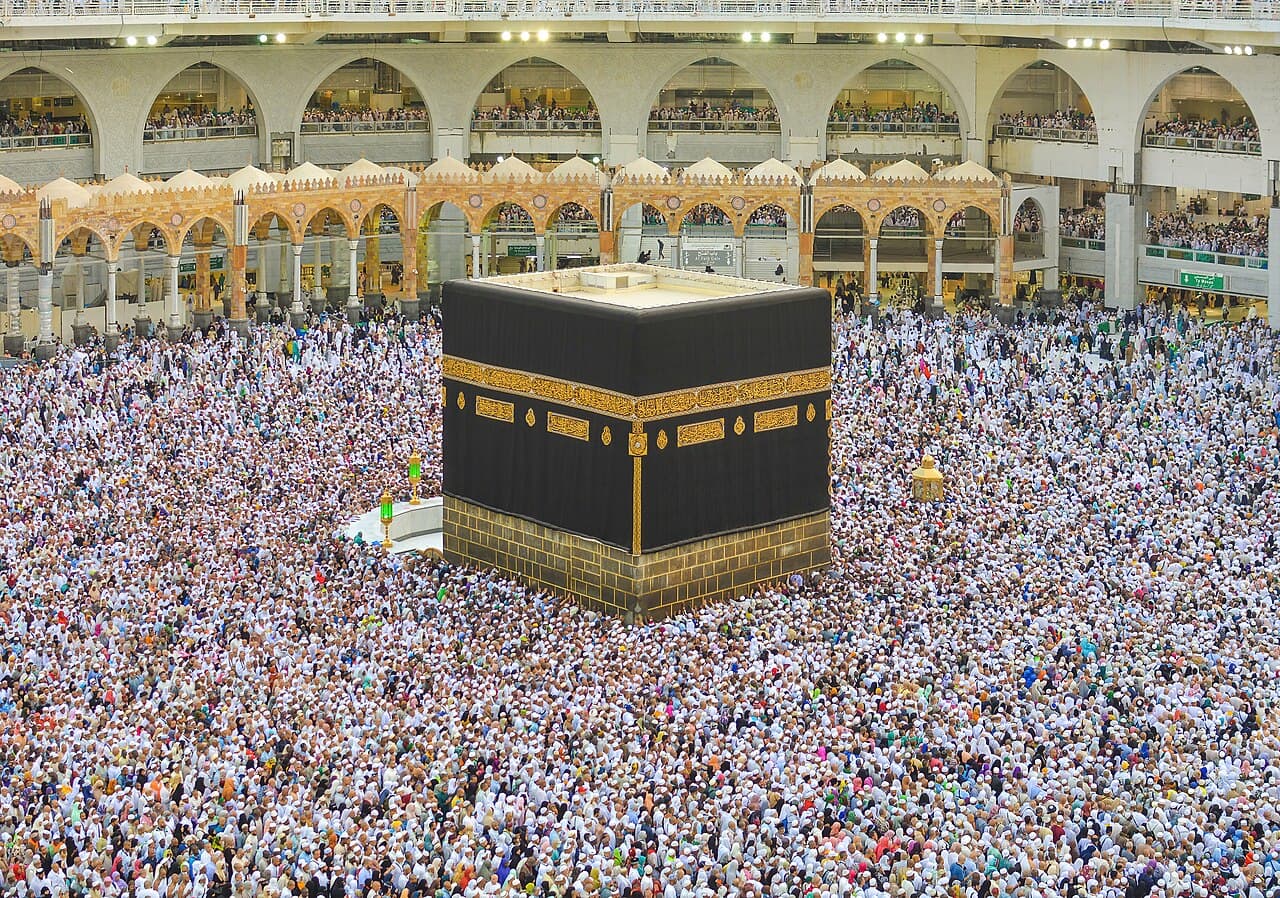
If access cannot be confirmed, the craft remains worth studying through official photographs and reporting. Use the finished Kiswa image only as evidence of the completed object, not as a workshop interior. Record the source date beside every operational note, omit copied hours, and follow any current authority directions. A responsible article can illuminate manufacture while leaving admission unresolved; the educational value does not depend on manufacturing certainty about a visit.
- Open the current official complex page.
- Verify the responsible reservation channel.
- Treat confirmation as date-specific.
- Do not infer workshop access from a general listing.
Useful answers
Reader questions
Is the Kiswa made entirely by hand?
Official sources describe both modern machinery and specialist hand embroidery. Different stages use different methods within one coordinated production system.
Sources: General Authority for the Care of the Affairs of the Grand Mosque and the Prophet's Mosque; Saudi Press AgencyWhat materials do official sources identify?
Saudi official reporting identifies natural silk and embroidery using gold- and silver-plated threads. This article does not add unsupported recipes or production specifications.
Sources: Saudi Press AgencyCan I assume the Kiswa complex is open to individual visitors?
No. Official destination material refers to prior coordination or reservation, but current eligibility and availability must be confirmed through the responsible official channel.
Sources: Discover Makkah, Royal Commission for Makkah City and Holy SitesRead the evidence
Sources and further reading
These sources support the relevant sections above. Plans and comparisons are editorial suggestions. Check operators for current arrangements.
- King Abdulaziz Complex for the Kaaba Kiswa ↗Discover Makkah, Royal Commission for Makkah City and Holy Sites · Research date 14 September 2026
The complex's linked production departments and the need to check current visitor coordination or reservation.
- Holy Kaaba Kiswa Complex: Precision Craftsmanship and Living Islamic Heritage ↗Saudi Press Agency · Research date 14 September 2026
Natural silk, precision production and embroidery using gold- and silver-plated threads.